
I’ve been repeatedly deplatformed by Meta. My whole online history evaporated in an instant: over ten years of daily posting, 4000 posts, 1.5 million followers. I was able to find my way back online, but it wasn’t easy... or cheap. I’ll write the full story soon.
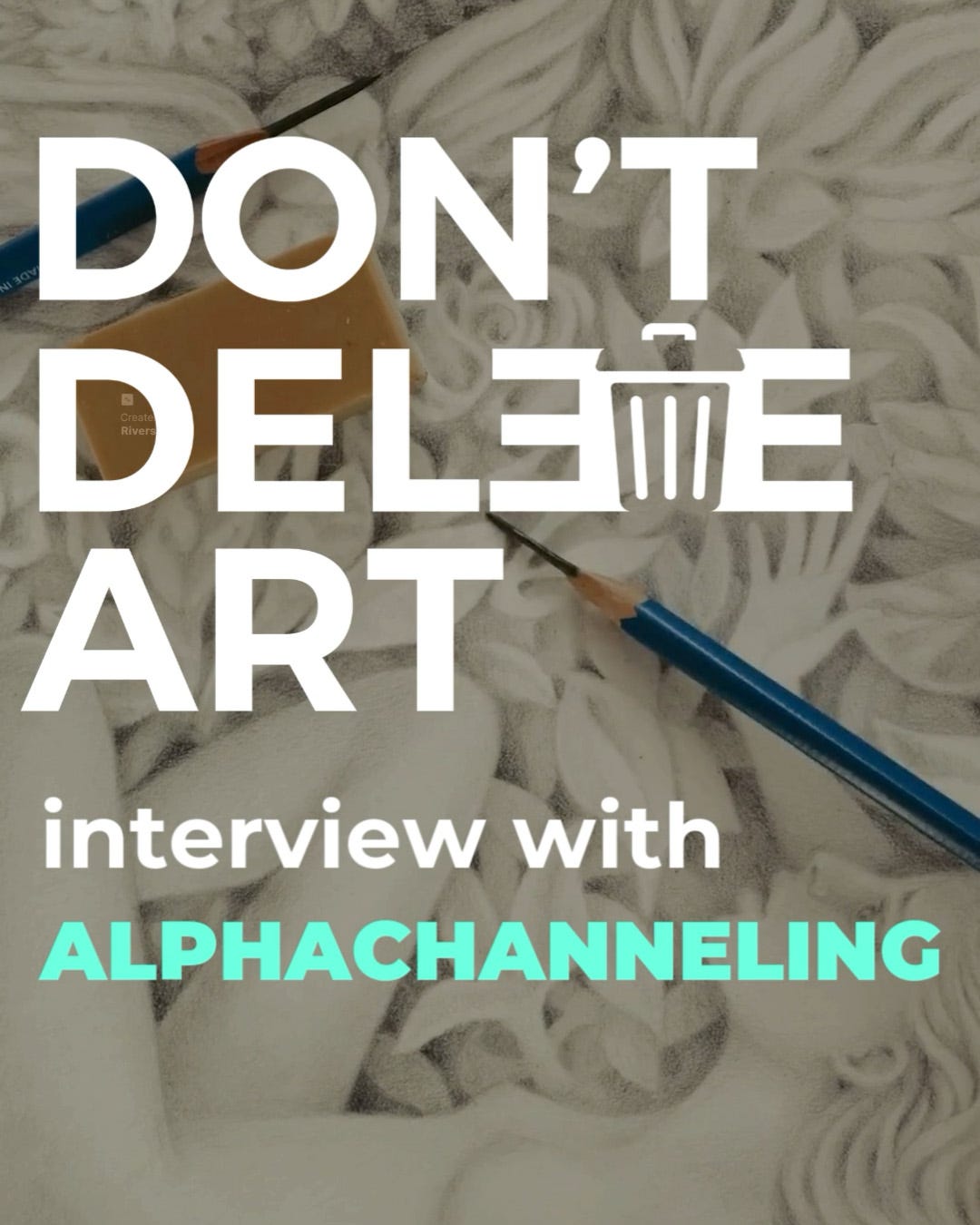
Recently Emma Shapiro from Don’t Delete Art invited me to share my perspective for their DDA Interview With... podcast series. Don’t Delete Art advocates for artists facing censorship and algorithmic suppression online. We spoke about what it means to keep creating in a climate that increasingly filters out intimacy and erotic expression.
Listen to our conversation.
Listen on Spotify / Watch on YouTube / Read on Blog
Here are a few moments from our conversation.
“The loss of creativity is silent”- On disappearing from the internet overnight:
Alphachanneling: The thing that you think is familiar doesn’t show up one day and you don’t notice it right away and you start to get used to other things in that space. I don’t know the artists that have disappeared from my own social feed because I only track them because they were present. Are they still making stuff? Am I not seeing it? I would have to go investigate them and half the time you don’t remember exactly what’s their name or what’s their handle. Things can disappear — the loss of creativity is silent. Silent. And because of the nature of it, we all just assume many things other than that person was taken away from us.
“A cultural lobotomy”- On what censorship of sexuality actually means:
ES: Your artwork is this celebration of safe space, about enjoyment and freedom — where does that belong if it’s having to face this antagonism? How does being in a hostile environment change the message of it?
Alphachanneling: The censorship of sexuality, of sex positivity, of all of these topics feels like this cultural lobotomy — let’s surgically exclude this central piece of humanity in our media, in our collective repository of humanity.
Audre Lorde wrote: “In touch with the erotic I become less willing to accept powerlessness or those other supplied states of which being are not native to me such as resignation, despair, self-effacement, depression, self-denial.”
Alphachanneling: I’m honoring myself and being true to my joy in making it — but while I’m making it, I’m understanding that this is working against me in my world. This devotion of my time and my energy will be creating problems for me.
“Why would you want your work to be invisible?”- On the impossible choice between integrity and survival:
ES: We’ve developed an entire visual vocabulary of how to try to trick an algorithm away from identifying the human body just to be able to include it. It’s such an absurd game that we play.
Alphachanneling: If you use a nude body, it’s a machine who’s going to visually scan the image, detect what’s in it, and if it sees anything that has association or resemblance to a nude figure, it will get filtered. So how could you ever include those things knowing that the tiniest inclusion of anything that trips the system will make your work invisible? Why would you want your work to be invisible? If you could just not put that figure in, then the whole world will get to see what you’re making. And if you refuse to obscure it, you’ve maintained your integrity, but it will never be experienced. It’s such a crazy way of making art.
Don’t Delete Art is part of a campaign dedicated to free speech and human rights that calls on social media platforms to follow a set of principles that would allow art to circulate freely online. If your art has been removed, downranked, or restricted online, you can submit a Censorship Report through Don’t Delete Art.